The seven lost pages from Nixon’s grand jury appearance expose the original “Deep State” conspiracy
02/15/2026 / By Lance D Johnson
For decades, the official Watergate narrative has been a carefully managed story of a paranoid president brought down by his own criminality. But what if the full story reveals that Richard Nixon was not just a perpetrator, but also a target? Newly unsealed testimony, buried for nearly 50 years by the very prosecutors who interrogated him, exposes a constitutional crisis far more dangerous than a third-rate burglary: a military-led espionage ring operating inside the White House to subvert the Commander-in-Chief. This is a documented conspiracy, hidden in plain sight by a system desperate to protect its own. The seven pages finally released from Nixon’s 1975 grand jury appearance, obtained by The New York Times, prove that the “deep state” is not a modern invention, but a permanent and powerful force willing to spy on, steal from, and sabotage a sitting president.
Key points:
- Seven pages of Richard Nixon’s 1975 grand jury testimony were classified and sealed by White House and prosecution officials, hidden for 49 years.
- The redacted testimony details the “Moorer-Radford affair,” a military espionage ring in which the Joint Chiefs of Staff used a Navy yeoman to steal thousands of top-secret documents from the National Security Council.
- Yeoman Charles Radford, a stenographer, systematically raided the briefcases and files of Henry Kissinger and Alexander Haig, funneling intelligence to Admiral Thomas Moorer, Chairman of the Joint Chiefs.
- Nixon and his top aides discovered the spying in 1971 but chose to bury it, fearing exposure would devastate the military’s public image and reveal other secret operations.
- The testimony reveals Nixon believed prosecuting the mole would risk exposing his secret China diplomacy and prolong the Vietnam War, forcing him to obstruct justice to protect national security.
- This historical episode provides concrete evidence for what is now called the “deep state”: entrenched bureaucratic forces actively working to undermine presidential policy they oppose.
A “can of worms” the prosecutors feared to open
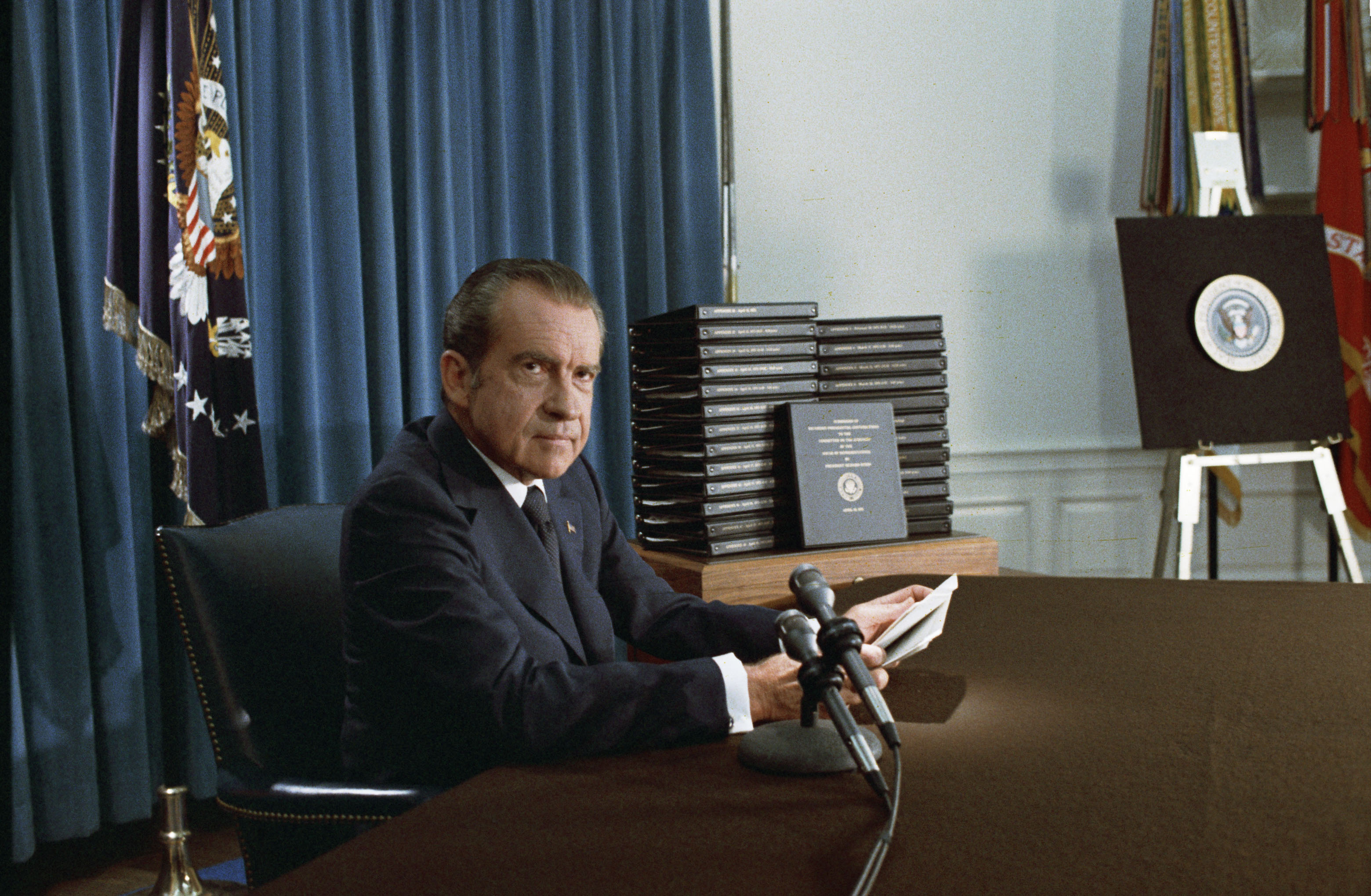
Imagine the scene: June 1975, a Coast Guard station in San Clemente, California. A disgraced Richard Nixon, the only president ever to resign, is under oath before a Watergate grand jury. The prosecutors think they are there to extract final confessions about wiretaps and break-ins. But as the questioning turns to a mysterious “Radford project,” Nixon issues a chilling warning: “I would strongly urge the special prosecutor: Don’t open that can of worms.” Astoundingly, they listened. The lead prosecutor, Henry Ruth, agreed to stop the line of questioning. The relevant seven-page segment was physically removed, stamped “classified” by Deputy National Security Adviser Brent Scowcroft, locked in a White House safe, and forgotten. Why would Watergate prosecutors, dogged in their pursuit of Nixon’s crimes, suddenly become complicit in a cover-up? Because what Nixon began to describe wasn’t just about his corruption—it was about the corruption of the entire national security apparatus against him.
The “can of worms” was an unprecedented act of subversion. During the height of the Vietnam War and Nixon’s secret China diplomacy, the Joint Chiefs of Staff, feeling sidelined and hostile to Nixon’s policies, ran a spy ring. Their asset was Yeoman Charles Radford, a seemingly low-level clerk with a photographic memory and access to everything. Stationed in the NSC liaison office, Radford didn’t just leak; he conducted a wholesale document harvesting operation. He copied everything, dove into burn bags, and even rifled through Henry Kissinger’s briefcase during the secret trip to China. He delivered an estimated 5,000 stolen documents to his Pentagon handlers. This wasn’t bureaucratic rivalry; it was a systemic, treasonous intelligence operation against the sitting president and his national security adviser.
The President’s hands were tied by the guardians of the state
When Nixon was briefed on the scandal in December 1971, the White House tapes reveal his fury. He called it “a federal offense of the highest order” and initially demanded Admiral Moorer be prosecuted. But his advisers, Attorney General John Mitchell and John Ehrlichman, quickly shut that down. They reminded Nixon of all the illegal wars and covert operations—like the bombing of Cambodia—that a trial would expose. Mitchell coldly advised a cover-up: transfer the spies, wiretap the yeoman, and tell Moorer the “ballgame’s over.” Nixon, the man who would be destroyed for a cover-up, reluctantly agreed to another one. He confessed on tape that to protect the reputation of the military and his secret plans to end the Vietnam War, he had to let the conspirators go free. He even protected General Alexander Haig, who evidence suggests was complicit. The system closed ranks. The Pentagon investigators likened it to Seven Days in May, a film about a military coup. The Senate Armed Services Committee, upon holding hearings, whitewashed the affair and cleared Moorer.
In his grand jury testimony, Nixon laid bare the impossible choice. Prosecuting Radford, he argued, would have made the yeoman “blow the whole thing,” exposing the secret China backchannel brokered through Pakistan. “The war in Vietnam would have continued for a while longer,” Nixon testified. “I had to make a decision.” So he chose to obstruct justice, a fact he admitted under oath, to contain a scandal that threatened the very foundations of civilian control over the military. The deep state had won by making its exposure more dangerous than its crime.
The same forces that spied on Nixon—a military and intelligence community enraged by a president’s disruptive foreign policy—have never left. They simply adapt. When a president today speaks of being surveilled, undermined, or sabotaged by a “permanent bureaucracy,” he is not describing a fantasy. He is describing the legacy of the Moorer-Radford affair, a proven conspiracy where the most respected institutions became instruments of sedition.
Sources include:
Submit a correction >>
Tagged Under:
Alexander Haig, Bureaucratic Sabotage, Charles Radford, Cold War, conspiracy, Cover-Up, deep state, government corruption, grand jury, Henry Kissinger, historical revision, joint chiefs, Military Espionage, national security, presidential power, Richard Nixon, Sealed Documents, secret testimony, Thomas Moorer, watergate
This article may contain statements that reflect the opinion of the author
RECENT NEWS & ARTICLES